
What are AEO and GEO and why do you need to know about them?
Marketing loves its little abbreviations and acronyms doesn’t it? As if SEO, SERPs and the myriad of other search-related terms weren’t enough, we now have AEO and GEO. So, what exactly do these terms stand for and – more importantly – why do you need to know about them?
Broadly speaking, Answer Engine Optimisation (AEO) and Generative Engine Optimisation (GEO) are both cornerstones of Artificial Intelligence Optimisation (AIO – another abbreviation, yay!).
AIO is an umbrella term for (a) optimising content for AI search results and (b) using AI to help with other SEO tasks, such as keyword research and content creation. We’re only concerned with (a) today, which covers AEO and GEO. Let’s start with AEO.
What is Answer Engine Optimisation (AEO)
AEO is the practice of structuring your online content so that search engines and other platforms can easily extract it as a direct, concise answer to a question.
AEO targets voice assistants such as Siri and Alexa as well as ‘traditional’ search engines. With the latter, the main aim is for your content to appear in the AI Overview at or near the top of the page in the SERPs, and / or in the information provided when AI Mode is selected (more on this below).
To a lesser degree, AEO also targets large language models (LLMs) such as ChatGPT, Google Gemimi, Claude and Perplexity, although these are more closely associated with GEO.
The purpose of an AEO search is to produce a snippet of information that answers the user’s question instantly on the screen. This is why AEO (and GEO) searches are often referred to as ‘zero click’ searches, as the user often doesn’t need to click on a link and visit another website to find the information they need.
How does AEO work on a search engine?
Taking Google as our search engine1, when you type in a question and it generates an AI response, the answer will be labelled as ‘AI Overview’ (previously called Search Generative Experience (SGE)). To create its answer, Google will look across the entire web, including Reddit, YouTube, LinkedIn, review sites such as Trust Pilot and Tripadvisor, and the websites of brands it has come to ‘trust’. The ‘trust’ bit is partly derived from Gemini.
The questions answered in AI Overviews tend to be knowledge-based or subject-specific, rather than ‘nuts and bolts’ questions such as ‘Where is my nearest vet?’ or ‘What time is it in Singapore?’ The latter still tend to be answered by the search engine itself, unless you choose to click on ‘AI Mode’.
Here’s an example of an answer to a knowledge-based question on Google, with ‘All’ selected as the results setting (‘AI Mode’ is to the left):
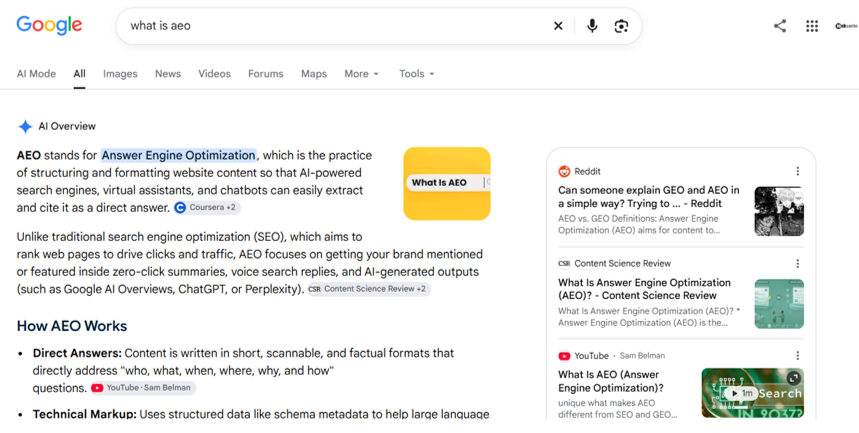
If AI Mode is selected, the result is similar – but notice that the primary sources under the AI-generated text have changed. Some of the links to the right are also different, although Content Science Review appears in both responses as a primary source and a link on the right hand side of the page (both links go to the same web page). This indicates that Content Science Review is a trusted source of information for Google.
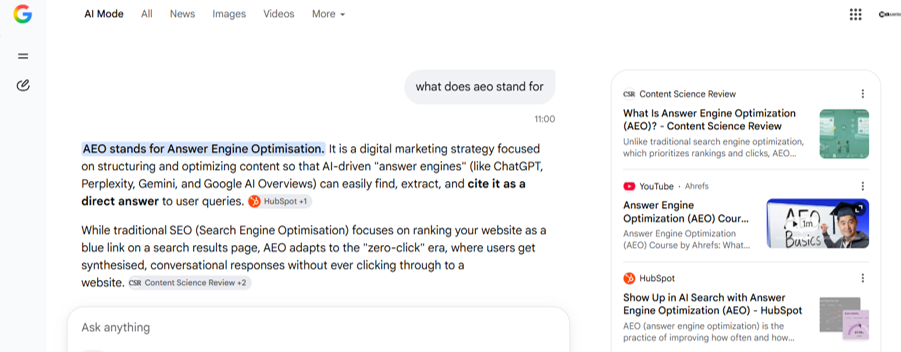
Although only the top parts of the screenshots are visible above, the response in AI Mode goes into more length and detail than the AI Overview. This is because, even though both responses use customised (and different) versions of Gemini as their underlying ‘brain’, the intent is different.
The AI Overview simply answers a question. AI Mode goes deeper, providing information in a similar conversation-based format to that provided by an LLM, but not in exactly the same way. (Another thing to note is that if you click on the ‘Ask anything’ box under an AI Overview and type in a question, you’ll automatically be switched into AI Mode.)
Using Gemini directly provides a different experience again, as we’ll see in a moment. Which brings us onto our next topic: What is GEO?
What is Generative Engine Optimisation (GEO)?
GEO is the practice of structuring and refining your online content so that AI-powered searches and LLMs can easily find and understand it and, hopefully, mention or cite your brand as a source. These citations appear on search engines in the same way as those that show up for AEO searches (as seen in the screenshots above), but things are a bit different with responses provided by LLMs such as Gemini and ChatGPT.
The main reason for this is that LLMs are ‘trained’ to respond to instructions, requests and questions – known as prompts – based on their internal knowledge where possible. This means that, for commonly-asked questions such as ‘What is AEO?,’ there won’t be any brand mentions or citations, because Gemini already knows the answer. You can see the difference in the answer to this question when entered as a prompt on Gemini:
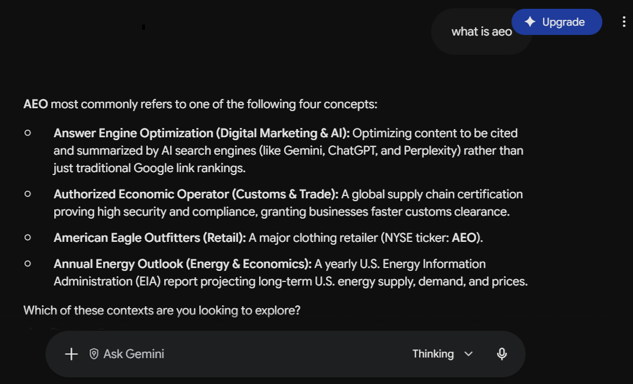
Gemini provides a much broader answer to ‘What is AEO?,’ bringing in four alternative meanings for the abbreviation. This is because, unlike Google, Gemini isn’t pre-programmed to select responses based on pure search volumes.
To explain further, ‘Answer Engine Optimisation’ is the answer most people want when typing ‘What is AEO?’ into Google, so that’s what Google shows as its answer. Gemini goes deeper and performs a much wider-ranging analysis of its own vast data sets and, if necessary, the external web to give a range of possible answers. The user can then type in further prompts to dig deeper into the definition of AEO they’re looking for, as indicated by the question underneath the four definitions.
However, in this instance, Gemini’s internal data is so well-versed that the response to the secondary prompt ‘I’d like to explore Answer Engine Optimisation’ (not shown) doesn’t include any citations or brand mentions, either. The ever-increasing ‘training’ that Gemini and the other LLMs are subject to means that, unfortunately for marketers, it’s getting harder to get brand mentions or citations on their responses.
With this in mind, many businesses are now focusing on trying to get their content mentioned or cited in results within AI Overviews and AI Mode alone, i.e. AEO. But GEO practices can’t be left out of the equation altogether in a modern search strategy. Many people – especially Generation Z and younger – are now abandoning traditional search engines in favour of LLMs and other AI-driven search tools. So, you need to try and get your content to show up on these tools if your brand is to be discovered online.
To make matters even more complicated, ‘traditional’ voice search is also evolving rapidly. The recently-introduced Siri AI2 moves away from the original command-based format, linking the technology to LLMs to provide a conversational experience and other advanced features. Alexa+3, the newly-upgraded version of Alexa, lags behind in some respects but, like Siri AI, is now powered by LLMs.
So, how can you get your brand mentioned or cited on AI-driven search engine results, voice assistants and LLMs? And how does all this tie in with traditional SEO practices that simply aim to get your web pages listed as high as possible in the SERPs?
Book on my FREE AEO, GEO and SEO webinar to find out!
Getting cited or mentioned as a result of AEO and GEO practices is a tricky one (especially GEO). This is one of the topics we’ll be exploring in my FREE webinar on Friday 16 October 2026 at 12 noon. The webinar is titled AEO, GEO and SEO – the future of search optimisation.
During the session, we’ll cover:
- What are AEO and GEO? (You’ll already know this bit from reading this blog!)
- How AEO and GEO work alongside SEO (and why SEO isn’t obsolete, despite ‘zero-click’)
- The benefits of adding AEO and GEO practices to your search optimisation strategy
- Using AEO and GEO practices effectively (tips and tricks).
There’ll be the opportunity to ask questions and share your own experiences with AEO and GEO if you’re already using them. I’ll also provide some information about my training and other services – don’t worry, there’s no hard sell, but if you do book another service after attending the webinar, you’ll get a special discount! Everyone who attends will also get the slides and recording link.
Book your FREE webinar place today
Please visit the webinar booking page on Eventbrite to book your place on AEO, GEO and SEO – the future of search optimisation: https://www.eventbrite.com/e/aeo-geo-and-seo-the-future-of-search-optimisation-free-webinar-tickets-1999902631607?aff=oddtdtcreator. I look forward to seeing you there!
If you’d like more information in the meantime, or to discuss working with me on your next copywriting, marketing consultancy or training project, please drop me a line at faye.stenson@blackandwrite.uk.
Notes
1 Different search engines display AI-generated results slightly differently. Microsoft’s Bing, for example, automatically provides a response generated by its LLM, Copilot, for relevant questions. This includes a very short, direct answer to the question with no source information, followed by extra details with linked sources provided. From the Home screen on Bing, you can choose to go directly to Copilot which, unlike Google’s AI Mode, works in exactly the same way as ‘normal’ Copilot.
2 You’ll need an Apple iPhone 15 Pro or Pro Max, or an M1 iPad or later and be running iOS 27 or later to access Siri AI. If your device is eligible, you can turn it on in the Settings.
3 You can get Alexa+ by saying “Alexa, upgrade!” to a compatible Echo device or by signing up through the Amazon Alexa+ Page. It’s included at no cost with Amazon Prime membership.